Deep dive
Company Spotlight: LoopUp
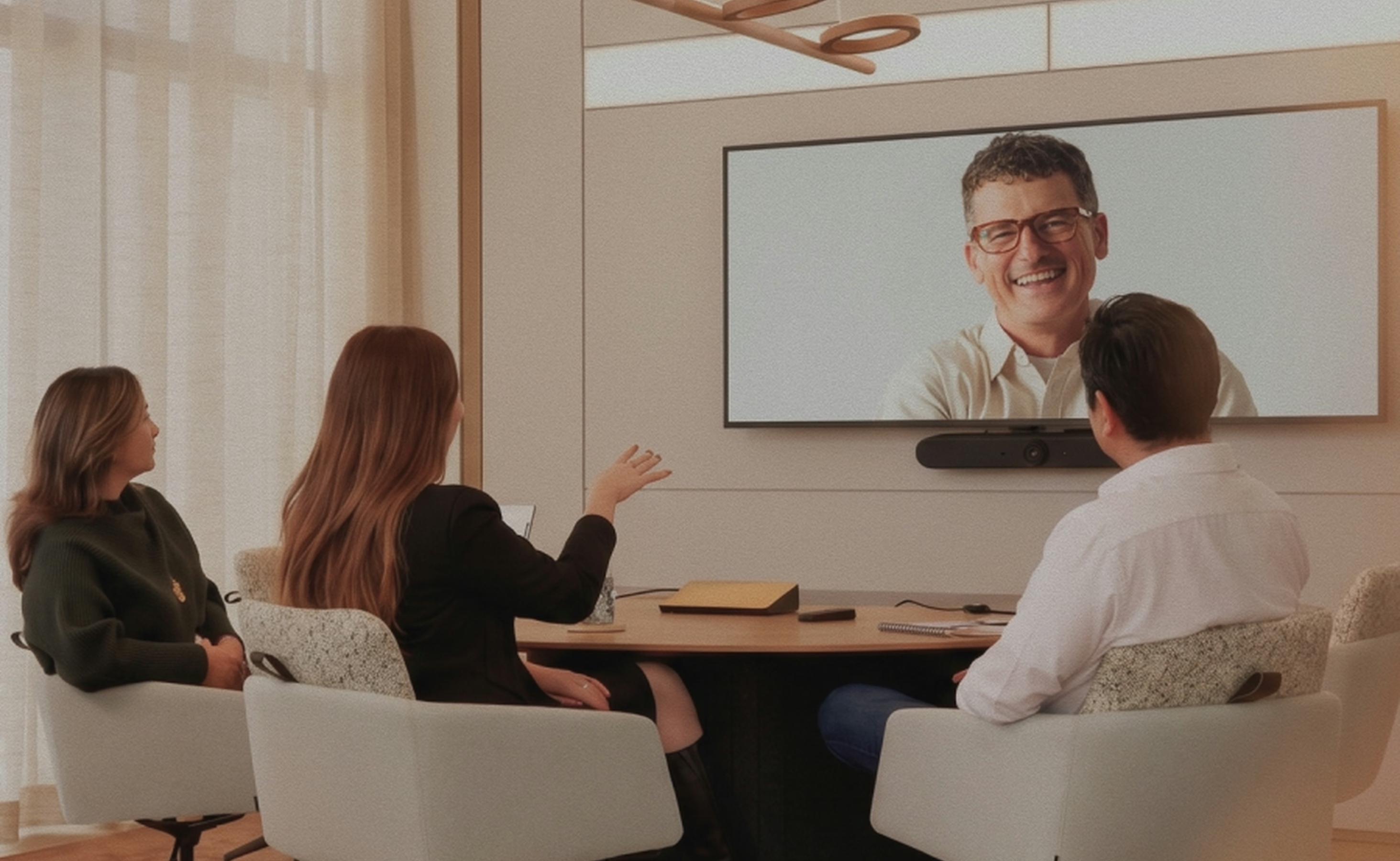

Reliable audio still gets sacrificed for flashy features, and global voice service for Teams still means juggling a dozen local carriers
Businesses run their most important conversations with clients, external counsel, regulators and partners, on tools built for internal chat and casual video calls. Collaboration software brings screen sharing and video, but audio quality and reliability are often the first to suffer, precisely on the calls where a dropped line or garbled audio is least acceptable. Separately, multinational enterprises that standardize on Microsoft Teams still have to solve for the problem of number provisioning and PSTN calling to work consistently across dozens of countries. This usually implies stitching together a different local carrier market by market, with no single vendor accountable for the whole footprint.
One managed platform for premium meetings, and one global vendor for Teams telephony
LoopUp's managed cloud telephony platform for Microsoft Teams gives multinational enterprises phone numbers and full PSTN-replacement calling in more than 100 countries through a single, consistent global vendor rather than a patchwork of regional carriers. The product is built around the same underlying premise as LoopUp's legacy remote meetings offering: a business call is not a casual one, and the infrastructure behind it should be treated with the reliability and security, including ISO/IEC 27001 certification, that assumption demands.
A London company now built around Microsoft Teams telephony
LoopUp is headquartered in London and runs today as a private company, with managed cloud telephony for Microsoft Teams as its core business alongside the remote-meetings platform it started with. It began in 2003 as Ring2, an audio-conferencing service for professional-services firms, took the LoopUp name in 2012 as the product broadened, and was listed on the AIM market of the London Stock Exchange from 2016, acquiring UK conferencing provider MeetingZone along the way in 2018. In 2024 the board took the company off AIM and back into private ownership, having concluded that the capital needed for its next phase was more readily raised privately than as a listed company, and it closed an equity round shortly after. That reset defines what the business is now: a tighter company focused on being the single global vendor behind enterprise cloud telephony, serving professional-services firms, multinationals and public-sector organizations that need dependable, secure voice infrastructure rather than another feature-led conferencing tool.
Co-chief executives, based in London
Steve Flavell and Michael Hughes MBE, who founded the company, serve as Co-Chief Executives, Flavell leading global commercial activities and Hughes product and platform worldwide. Marcus Greensit serves as Chief Operating Officer and Ed Cooper as General Counsel. The board is chaired by independent non-executive chairman Mike Reynolds, alongside non-executive directors Keith Taylor, Andres Proano and Andy Scott, and Adara's Nicolas Goulet.
Why we invested
We first backed the company in 2006, when it was still Ring2. Enterprise communication was already going global while the telecom infrastructure underneath it stayed fragmented country by country, and that mismatch, between how multinational businesses actually operate and how disconnected the plumbing behind their calls remained, is what drew us in. It is the same gap the company is closing today, now through Teams rather than a conference bridge. We backed the business through its listing on AIM and its acquisition of MeetingZone, and through the 2024 decision to take it private again and refocus it around cloud telephony.