Deep dive
Company Spotlight: XYZ Reality
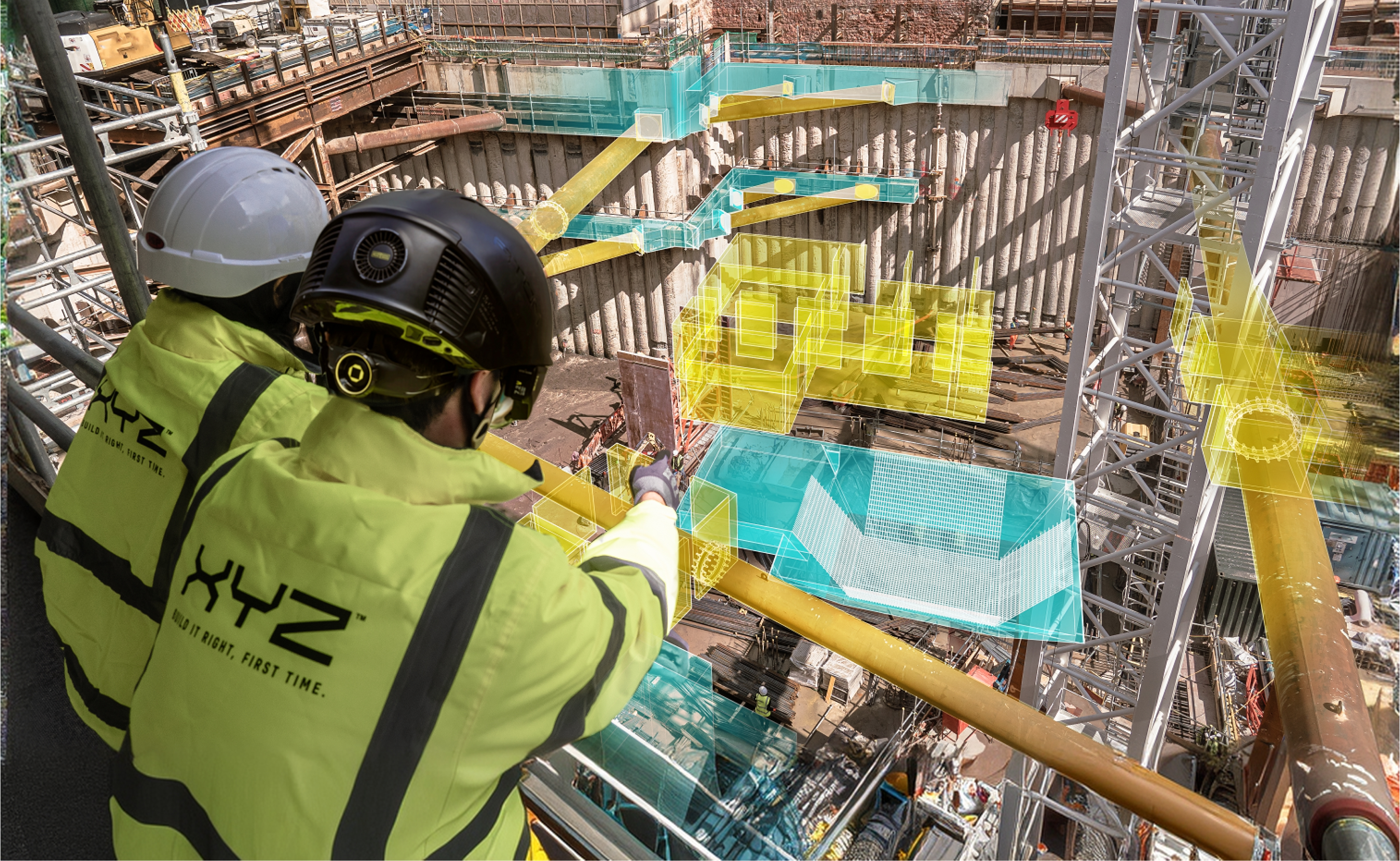

Construction still builds 3D projects from 2D drawings, and that conversion is expensive
People see the world in three dimensions, yet on-site construction still runs largely on 2D drawings converted down from an original 3D building model. Tradespeople are asked to interpret those flat drawings, reconstruct the 3D asset mentally, and then build to the tight tolerances the design actually requires. It is, as XYZ Reality's own CEO has put it, an unnatural language for a fundamentally spatial task. Construction remains one of the least digitalized major sectors of the economy, and the consequences of that 2D-3D gap show up throughout a project: large projects routinely run well over schedule and over budget, margins for general contractors stay thin, and validating that what got built on site actually matches the original 3D model is a slow, manual process. Work that fails that validation requires remediation, and rework of this kind costs the industry hundreds of billions of dollars a year worldwide.
Holosite: an augmented reality headset built for construction-grade accuracy
XYZ Reality's answer is Holosite, an augmented reality headset that overlays a building's 3D model directly onto the physical construction site, at the millimetric accuracy the industry actually needs rather than the looser tolerances most AR systems are built for. That accuracy is the point: it lets site teams catch a mismatch between plan and reality while it can still be fixed cheaply, instead of after the concrete has cured. The company describes this category as Engineering-Grade AR, and has built out a broader platform around it, including project-controls tools for tracking progress objectively across a portfolio of sites and a reality-capture validation layer for checking as-built work against the model.
From a London construction-tech startup to an established platform for mission-critical projects
XYZ Reality was founded in 2017. Built around a hologram headset for construction sites, its platform is used across data centers, pharmaceutical manufacturing, airports, and other mission-critical facilities where the cost of getting the build wrong is especially high. It sits in Real-World Systems in our sector taxonomy: Holosite only works because it is solving a physical, on-site problem, not a purely digital one, which is exactly the kind of defensibility that is harder for software alone to replicate.
An international team with strong domain expertise
Its founders are David Mitchell, Umar Ahmed and Murray Hendriksen. Mitchell, the Chief Executive Officer, came from digital construction, having worked on major projects including The Shard, Battersea Power Station and hyperscale data centres; his firsthand experience of the cost of rework shaped the company's focus on engineering-grade augmented reality. Ahmed, a former technology lead at Shell and London Business School alumnus, brought the operational and commercial perspective. Hendriksen, a chartered engineer with a background in automation, software engineering and AR/VR development, was the technical co-founder behind the product's engineering foundations. Mitchell leads an expanded executive team that includes Waleed Zafar, Chief Revenue Officer, and Soroosh Keshtgar, Chief Financial Officer.
When we invested, and what followed
We first backed XYZ Reality in 2020, participating in a £5 million round co-led by Amadeus Capital Partners and Hoxton Ventures, with a strategic investment from J. Coffey. We returned as an investor the following year, when the company closed a further Series A round led by Octopus Ventures, alongside Amadeus Capital Partners, Hoxton Ventures, and J. Coffey Construction, with new investors including Activum SG, Optimas Capital, and Tishman Speyer also joining. That funding has supported XYZ Reality's move from an early-stage product into a platform now deployed across some of the highest-stakes construction projects being built today.
Why we backed it
Construction is enormous and, by its own industry's admission, behind on digitizing the basic act of checking whether what got built matches what was designed. XYZ Reality's millimetric-accuracy approach to that problem gives the company a genuine edge at the core of an industry ripe for exactly this kind of technological shift, and it is why we have continued to back the team as the company has grown.