Perspectives
Purpose-Built Energy Robotics: Where Robots Earn Their Place in Energy Infrastructure

Introduction
Venture capital has returned to robotics with conviction. The sector attracted $27.6 billion across more than 1,000 deals in 2025, more than double the prior year. Defence and industrial robotics absorbed the majority: defence drew $8 billion across 234 deals, driven largely by unmanned aerial systems, while industrial robotics generated $6 billion across 201 deals, growing 70% year-over-year.
Despite heavy investment in industrial robotics, implementation tells a more measured story. IFR data shows 542,000 units were installed globally in 2024, bringing the operational base to 4.6 million, a continuation of the sector's established 10-15% annual growth plateau.
Humanoids represent a growing segment, where investor interest has moved well ahead of commercial deployment. In 2025, Figure AI raised $1 billion at a $39 billion valuation, while Agility Robotics raised $400 million and 1X sought up to $1 billion at a $10 billion valuation. Bipedal platforms are increasingly treated as a distinct asset class, one whose near-term industrial relevance remains debated, but whose longer-term potential is reshaping how investors think about the sector's ceiling.

Cracking the Energy Problem
The reason energy robotics has remained underdiscussed is the same reason it is structurally interesting: the operating environments do not map cleanly onto the general automation thesis that has attracted most of the capital described above. High voltage, saltwater corrosion, extreme depth, and blade-scale mechanical stress define conditions where consumer drones and nascent humanoid platforms do not function. What has emerged instead is a set of highly specialised companies, each engineered around narrow, high-value problems.
Transmission and distribution. The core inspection challenge is coverage: overhead lines span thousands of kilometres through remote terrain, requiring beyond-visual-line-of-sight operation that conventional drones cannot legally or practically support. Purpose-built airship platforms are being developed for extended-endurance line inspection at range. Where inspection gives way to intervention, the specificity deepens: line-mounted robots are navigating live conductors to perform helical armour-rod alignment and aircraft warning sphere installation, while thermal coatings are being applied directly to existing lines, increasing capacity by up to 30% without reconductoring or outages.
Subsea. Pressure, visibility, and distance from surface operations define the constraint set. The established response has been remotely operated vehicles, capable of underwater welding and structural intervention. A newer wave of autonomous platforms is emerging: compact hybrid AUV/ROV systems for offshore wind and cable inspection in high currents and low visibility, and solar-powered surface vessels with submersible capability, enabling long-distance missions no conventional ROV could sustain. Go-to-market in subsea is frequently bifurcated, with many of the same platforms serving both offshore energy and defence applications.
Solar. The purpose-built opportunity sits outside the inspection layer, which has largely been occupied by general-purpose drone fleets and service providers. The differentiated positions centre on operations and maintenance, where robotic panel cleaners deploy waterless systems to address dust-driven energy losses at utility scale, and on construction automation, where robotic assembly workflows are moving toward large-scale deployment.
Wind. The landscape splits between inspection and intervention. Drone-based inspection has seen meaningful commercial traction at scale. Intervention addresses a more technically constrained problem, with contact-based platforms for blade cleaning, sharpening, and maintenance at height.
Taken together, these companies form a developing ecosystem of purpose-built robotics applied to energy infrastructure: within our sample of companies founded post-2010, approximately $1.1 billion has been raised, supporting around 2,800 full-time employees.
Market Map
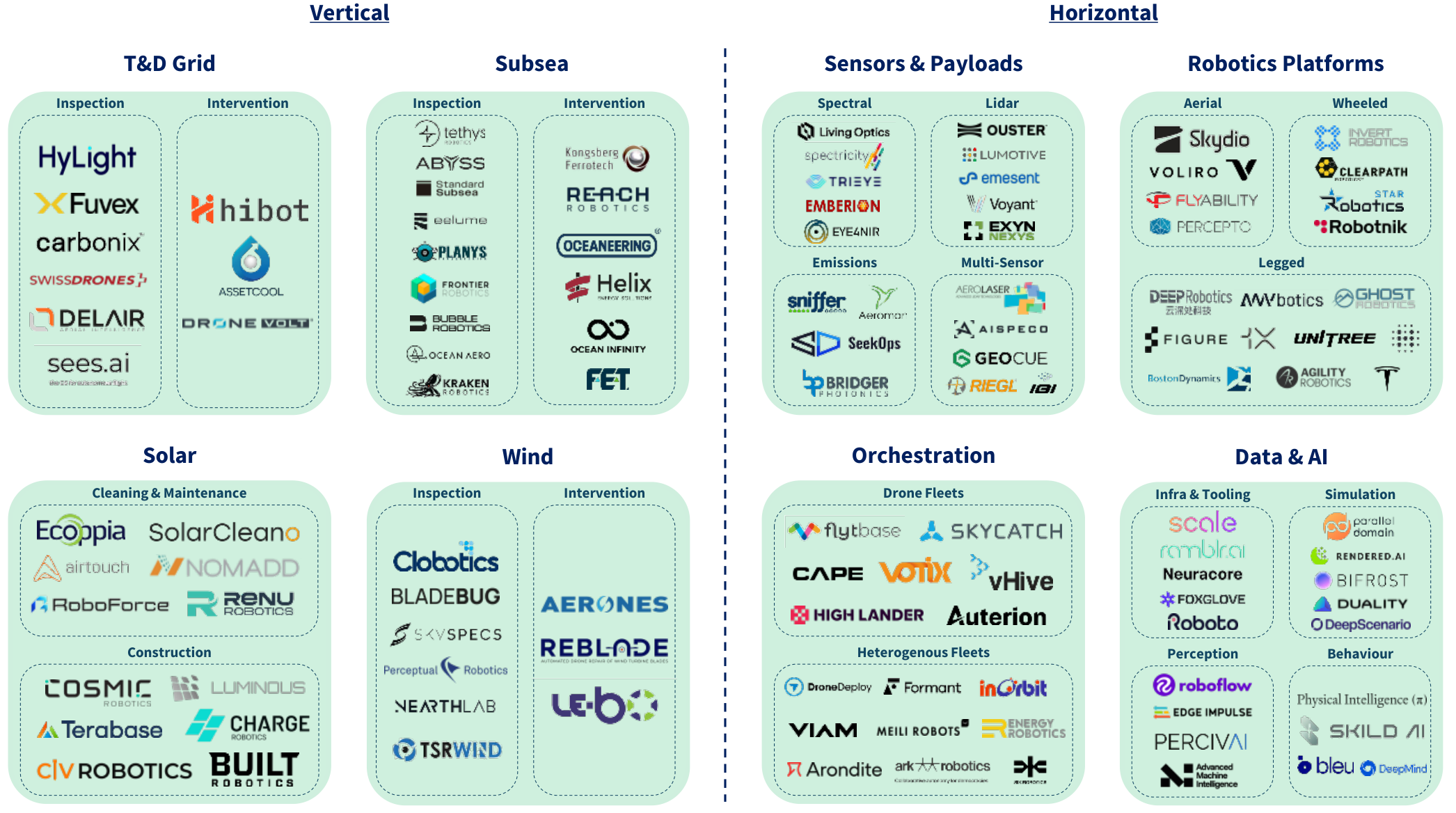
Where is the most value for robotics in energy infrastructure?
Value in robotics applied to energy infrastructure follows a consistent pattern. The strongest positions are built on problems that are physically hard enough to exclude general-purpose platforms, embedded in recurring operations-and-maintenance workflows where co-development with asset owners converts capability into switching costs.
Intervention is a more defensible position than inspection, but the distinction is not absolute: in the grid and subsea, the inspection problem remains genuinely hard, and players that build deep autonomy and proprietary data and AI positions in constrained environments can be as compelling as those performing intervention in less demanding settings.
The meaningful autonomy shift is not the removal of human operators, but the transition towards fleet-scale oversight, where human intervention is reserved for exception handling, a transition that is underway in standardised contexts but remains an open problem in non-standard and constrained ones.
The horizontal layers modulate rather than alter this thesis: Sensors & Payloads innovation reduces barriers for vertical players, Orchestration serves systems integrators and multi-vendor operators, Robotics Platforms will commoditise accessible inspection use cases but cannot yet serve complex energy use cases, and Data & AI represents a genuine value capture layer for those with deep deployment expertise.
Instead of highlighting a single vertical or activity, we prefer the framework followed by purpose-driven robots, rooted in the problem's value, complexity, and alignment with existing operations-and-maintenance flows, which we observed to be more defensible than horizontal robotics platforms.
Validating the Thesis: Live Pilots & Use Cases
Selected pilots and deployments provide validation of robotics applied to energy infrastructure operations and maintenance.
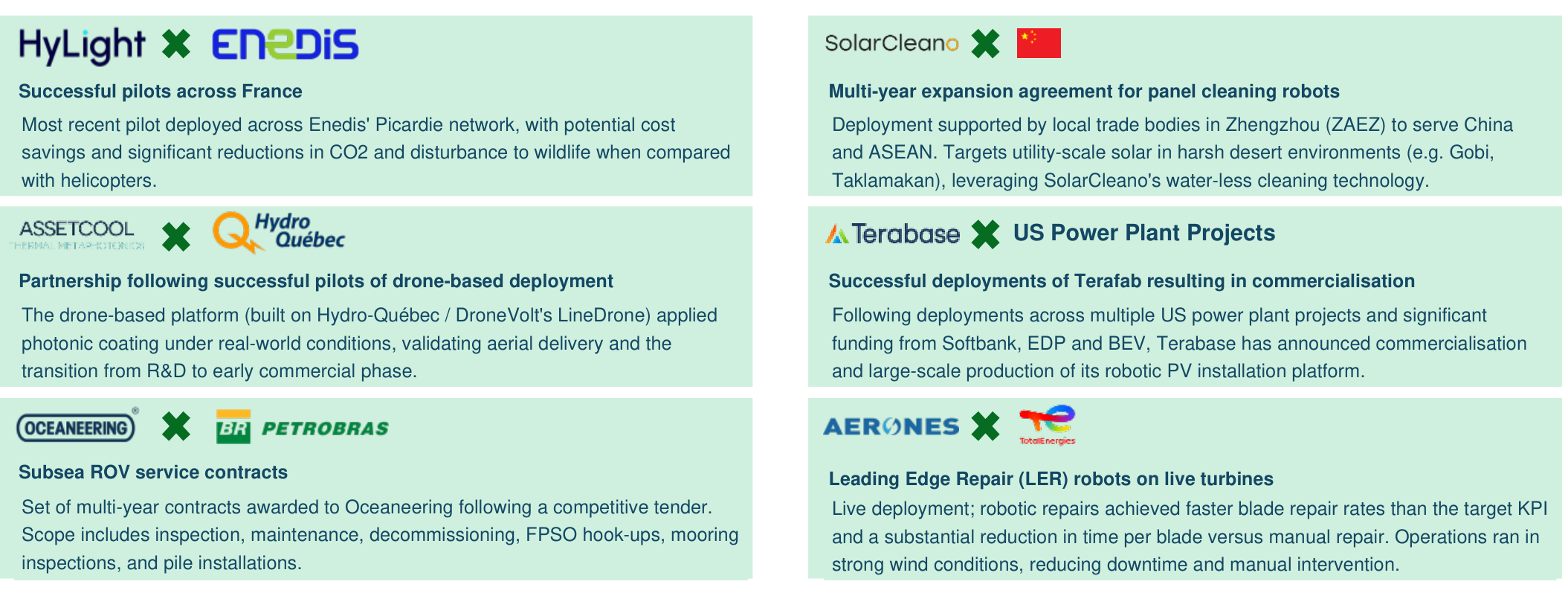
Early deployments point to real traction: multi-year subsea ROV service contracts awarded following competitive tender, covering inspection, maintenance, decommissioning and mooring work; leading-edge blade-repair robots achieving faster repair rates than manual crews across live wind-turbine deployments; utility-scale drone-based line inspection pilots reporting meaningful cost savings and lower environmental impact than helicopter surveys; a multi-year expansion agreement for hundreds of solar panel-cleaning robots in harsh desert environments; a photonic line-coating platform transitioning from R&D to early commercial deployment via aerial delivery; and a robotic PV installation platform reaching commercial-scale production following multi-site deployments and significant funding.
Spotlights
Insights from innovators driving the adoption of robotics applied to energy infrastructure
hibot is a Tokyo Institute of Technology spin-out developing robotic systems for the installation of helical armour rods, aircraft warning spheres, and clamps on energized transmission lines. By enabling maintenance on live lines, hibot reduces helicopter use, CO2 emissions, and personnel exposure to high-risk environments.
Co-development matters. Michele Guarnieri, Co-Founder & CEO, points to hibot's two-year collaboration with Terna developing the ExplinerT system for live-line maintenance: early alignment between innovation teams and business units, he says, was critical to defining technical requirements and operational workflows from the outset. In niche grid applications with long sales cycles, co-development is often essential to direct R&D and shape the product itself, accelerating validation and de-risking the business case, culminating in the commercialization of the ExplinerT robot and hibot's strategic investment from Terna Forward.
AssetCool, headquartered in Leeds with global operations, develops line coatings and robotic deployment systems for grid infrastructure. Its coatings boost ampacity, reduce corona noise, and protect against corrosion, deferring costly and potentially disruptive reconductoring projects.
Coating for grid infrastructure. Eshel Lipman, VP Business & Corporate Development, notes that in partnership with Hydro-Québec, AssetCool recently developed a drone system allowing its CapacityN platform to be deployed on energized lines, unlocking projects previously limited by outage costs. He points out that the value proposition of coating is not limited to capacity gains: second-order effects such as workforce efficiency and safety sit alongside capacity gains as part of a broader case for grid robotics.
Tethys Robotics is an ETH Zurich spin-out building autonomous subsea inspection systems for offshore energy, cable infrastructure, and defence. Tethys targets a 10x cost reduction across inspection workflows by replacing large support vessels and reducing offshore crew requirements.
Zurich's influence. Jonas Wüst, Co-Founder & CEO, credits the ETH Zurich ecosystem, access to top-tier talent and a dense network of researchers and industry partners, for accelerating hiring, knowledge transfer, and collaboration. Subsea environments, he notes, lack connectivity, operate under low-visibility conditions, and have historically underdeveloped technical ecosystems compared to terrestrial and aerial robotics, which led Tethys to develop its own datasets, algorithms, and sensor fusion methodologies from scratch. The company completed over 1,000 dives across eight R&D cycles before launching its first product in 2025.