Perspectives
Industrial Knowledge Gap: Rebuilding the Expertise that Energy Infrastructure Runs on

The expertise required to operate complex assets is increasingly fragmented, elusive and at risk of being lost
Some of the critical knowledge in companies exists nowhere the organisation can reliably access it. It lives in the judgment of a seasoned technician who can hear when a machine is running differently, in the memory of a shift team that has encountered a failure before, or with the contractor who has maintained an asset for years. This is the knowledge that allows companies to respond when a manual is incomplete, the data is ambiguous and the standard procedure no longer fits. Organisations often discover how much they depended on non-structured knowledge when the expert retires, the contractor changes or the asset fails.
We defined the industrial knowledge gap as the difference between the expertise an organisation requires to operate its assets and the knowledge its workforce can reliably access when a decision needs to be made. Several structural changes are widening that gap. In the United States, the proportion of manufacturing workers over the age of 55 increased from approximately 10% in 1995 to 25% in 2025. At the same time, BCG estimates that tacit, undocumented know-how can represent as much as 70% of critical maintenance expertise in some industrial sectors.
The consequences of this gap appear in slower diagnosis, longer repairs, repeated mistakes and greater dependence on a smaller group of specialists. The economic exposure is significant. Across the world's 500 largest companies, unplanned downtime is estimated to generate almost $1.4 trillion in lost revenue annually (Siemens). While missing knowledge is not responsible for this entire cost, the figure illustrates the value of preventing failures and restoring operations quickly.
Cracking the Energy Problem
The knowledge gap is particularly acute in energy because its infrastructure is built to outlast the people and organisations that maintain it. Grids, power plants and pipelines remain in service for decades, while workforces, contractors and technology suppliers change repeatedly.
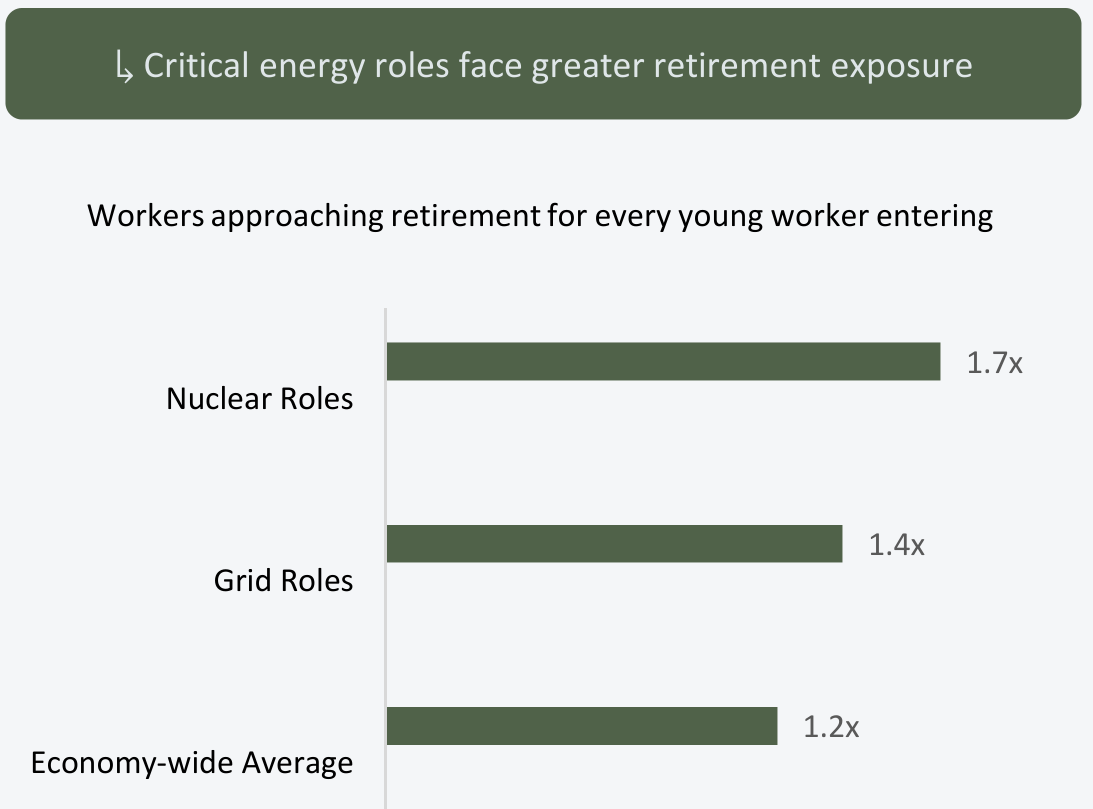
The first pressure comes from the aging workforce. The global energy sector employs 76 million people, but in advanced economies, 2.4 workers are approaching retirement for every worker under the age of 25 (IEA). The exposure is particularly high across complex infrastructure. Nuclear has 1.7 workers approaching retirement for every young entrant, while grids have 1.4. By 2035, two out of every three energy-sector hires will be required simply to replace retiring workers, while energy infrastructure keeps growing.
At the same time, critical operations and maintenance activities are increasingly performed outside the organisation. Outsourcing means organisations retain less critical informal know-how.
As an illustration, third parties perform 80% of maintenance activities across EDF's nuclear fleet in France. EDF has started selectively reinternalising activities and skills to rebuild its knowledge of equipment, strengthen technical procedures and improve its ability to oversee external providers.
These effects compound. Retirement removes existing knowledge, while outsourcing accumulates expertise. The result is a gradual erosion of the operator's institutional memory.
Traditional knowledge systems preserve procedures, but rarely the judgement behind them. Emerging technologies capture expertise as work happens, structure it and return it to workers through guidance and training. The objective is simple: make critical knowledge independent of the person or provider that holds it.
Validating the Thesis: Live Pilots & Use Cases
Market Mapping
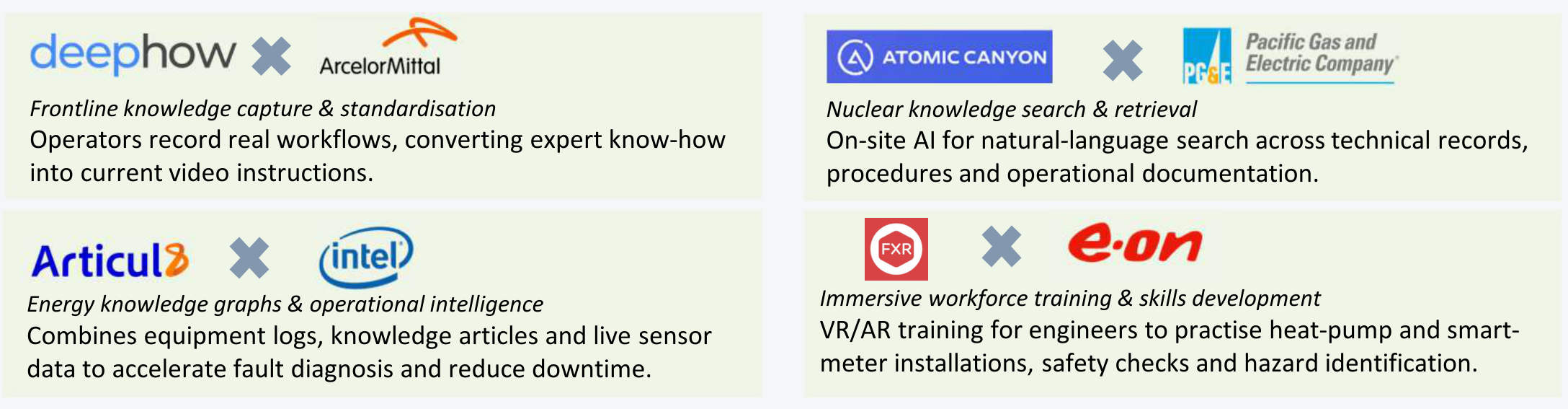
Emerging solutions address the operational knowledge gap across three interconnected areas.
- Frontline capture solutions use mobile devices, video, voice, sensors and wearables to record how tasks are performed, including the decisions, deviations, workarounds and expert reasoning that rarely reach formal documentation. They can also return relevant information or remote expert support to workers during execution.
- Knowledge grounding and intelligence platforms combine this captured expertise with manuals, maintenance records and operational systems, using knowledge graphs, asset hierarchies and AI to connect information to the relevant equipment, task and operating context. This turns fragmented information into contextualised, searchable knowledge that workers and AI applications can reliably use.
- Readiness and training solutions translate operational knowledge into role-specific, multilingual learning, realistic simulations and guidance delivered at the point of work. They also assess whether workers have the skills and proficiency required for tasks and identify where further intervention is needed. Worker feedback and performance data can then flow back into the knowledge base, allowing instructions and training to evolve alongside operations.
While new technologies to capture information and training solutions are incremental innovation, we consider connecting the formal and informal expertise from disparate sources as the most critical piece.

Rebuilding Industrial Memory
For decades, industrial companies have treated operational expertise as a characteristic of their workforce, rather than an asset to be deliberately captured and managed.
AI changes the economics of addressing this problem. Capturing tacit knowledge has historically required additional documentation, manual interpretation and significant effort from the people performing the work. New technologies can bring that capture closer to the activity itself, while making fragmented information easier to structure and retrieve. Yet capture alone has limited value. The real challenge lies at both ends: recording expertise without disrupting work and returning it at the moment a decision must be made.
The market is unlikely to resolve into a single solution or category. Horizontal platforms may eventually span the full knowledge lifecycle, but specialised solutions could equally emerge at each stage. In either case, turning industrial expertise into a durable organisational asset could create several significant markets while addressing one of industry's most overlooked risks.